


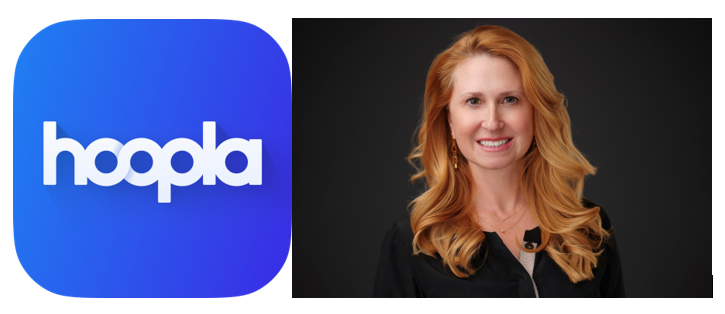
10 Sep Hoopla Member Profile | Meet Cat Zappa, VP Digital Acquisitions
September 10, 2026 | DEG welcomes Hoopla, a digital platform connecting public libraries with digital entertainment, as a new member. The specialty distribution service is a division of Midwest Tape, which has been serving public libraries exclusively for more than 30 years. Hoopla distributes millions of titles across multiple digital media formats to thousands of libraries across the U.S. and several other countries.
DEG caught up with Cat Zappa, Hoopla’s VP Digital Acquisitions, to discuss how Hoopla complements content owners’ primary commercial distribution channels and helps public libraries build trusted digital collections, including identify content created with or influenced by AI.

DEG: Hoopla is a digital platform connecting public libraries with digital entertainment. Will you tell us about how the connection between Hoopla and local libraries works?
CZ: When a library partners with Hoopla, they have access to the full Hoopla digital collection for their patrons across six different formats: audiobooks, eBooks, comics, movies, TV and music. Each library is also able to set its own borrowing policies, like monthly checkout limits, giving it the flexibility to align digital collections with local priorities and patron needs. Hoopla supports libraries with a range of licensing models which vary depending on the format of the content so they can build well-rounded collections.
DEG: Do you have any direct relationship with library patrons?
CZ: While libraries and publishers are our direct partners, every product decision we make starts with the patron experience. We work hard to create an easy-to-use platform that helps patrons discover and enjoy digital content, while providing reliable customer support through patron-facing social channels, email, in-app marquees that showcase trending content as well as in-library events for patrons to gather and experience interactive content on Hoopla together. We also pay close attention to how people are discovering and engaging with content. By listening to our library partners, following broader entertainment trends and continuously improving the patron experience, we’ve introduced innovations like BingePass and SeasonPass, which give patrons seven days of unlimited access to select streaming collections or an entire TV season with one single borrow.
Ultimately, our role is to strengthen the connection between libraries and their communities. We provide libraries with the tools and content they need to build strong digital collections while making it simple for patrons to access and enjoy those resources through their local public library.
DEG: Hoopla is a secondary sales channel for most content companies. Please define that channel – geographically? Types of libraries? Does Hoopla distribute entertainment to any other types of institutions?
CZ: For most content companies, Hoopla complements their primary commercial distribution channels. We partner with thousands of public libraries across the U.S., Canada, Australia and New Zealand, helping publishers, studios and other content owners reach library patrons. Our primary focus is and has always been public libraries since the platform’s founding in 2013. By working through libraries, we’re able to connect millions of patrons with digital ebooks, audiobooks, comics, music, movies and TV while supporting libraries’ missions to provide equitable access to content.
For content partners, Hoopla represents another way to reach audiences who may discover new authors, franchises and series through their local library. It’s a complement to traditional retail, subscription and ad-supported distribution models and helps expand access through a channel that’s purpose-built for discovery and community engagement, all while monetizing for the content provider in a transactional vs consumption model.
DEG: Where do content companies typically place Hoopla in the lifecycle of title distribution? Do they consider Hoopla a transactional platform, subscription streamer, or AVOD/FAST?
CZ: The reality is every content company looks at Hoopla a little differently. While most classify us under TVOD rights because the patron individually selects the content they want to borrow, others view public libraries as part of the educational market and license Hoopla under EDU rights. Some focus on the fact that patrons aren’t paying Hoopla directly, and instead align us more closely with AVOD models, where a third party pays for content access. Our contracts are intentionally flexible, allowing us to work across a variety of rights models. Across the board, we have seen content providers identify Hoopla as TVOD, AVOD/FAST, SVOD, EST, DTR, EDU, FVOD – and in some cases hybrids of several models.
DEG: You have an interesting approach to AI and for over a year have been helping libraries identify content that’s been created using AI. Tell us about that.
CZ: Libraries asked for greater transparency as AI-generated content has become more commonplace, and we responded by giving them more visibility into the content in their catalogs. We provide libraries with tools to identify content that may have been created or influenced by AI, using metadata supplied by our content providers complemented by our own catalog review process. Every library has its own collection development policies, so we believe librarians should have the information they need to make informed decisions. Our role is to support that professional judgement with accurate metadata and meticulous catalog curation, which involves hand-selecting each title by our video team, to help libraries build trusted digital collections while giving librarians the transparency they need to make informed collection decisions.
DEG: Are consumers looking to access different types of content from their public libraries than they are getting from commercial streaming services?
CZ: Consumers still want access to popular books, movies and TV shows, but increasingly they’re also looking for convenience, discovery and value. As subscription costs rise and entertainment becomes increasingly fragmented across platforms, public libraries offer a different experience. Patrons can discover a much larger range of content on Hoopla than most streamers today – not only with popular titles, but also hard to find niche content that most of the other streamers will not support. This helps to meet the need of the patron, particularly if they cannot afford subscriptions, thereby also extending the reach of the content into what may be an untapped audience for that content provider. The element of Hoopla’s user experience, no matter the format, being uninterrupted with no ads present is a win as well for the creator of the content from a storytelling perspective.

For more information, visit hoopladigital.com.